Identification and basic context
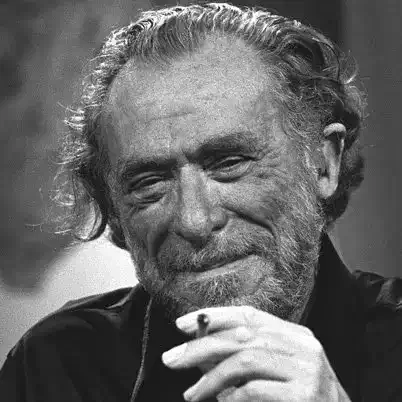
Heinrich Karl "Hank" Bukowski Jr. was a German-American poet, short story writer, and novelist. He was born in Andernach, Germany, on August 16, 1920, and died in San Pedro, California, United States, on March 9, 1994. He is a prominent figure in marginal literature and American counterculture. Son of German parents, he moved with his family to the United States when he was three years old.
Childhood and education
Bukowski had a difficult childhood marked by poverty and an abusive relationship with his father. At the age of three, the family emigrated to the United States, settling in Los Angeles. His adolescence was rebellious and problematic. He attended Los Angeles High School but dropped out early. At 17, he left home. His education was self-taught, shaped by intense reading, life experiences on the streets, and the precarious jobs he held for decades.
Literary career
Bukowski began writing poetry and short stories at a young age, but it took decades for him to gain recognition. He worked in manual labor jobs, such as a mailman and in factories, for much of his adult life, often struggling with alcoholism. He published sporadically in small underground literary magazines in the 1940s and 1950s. His literary career gained momentum in the 1960s when he dedicated himself entirely to writing after receiving an inheritance that allowed him to quit his job at the post office. His first book of poems, "Flower, Fist, and Bestial Wail," was published in 1960. From then on, he produced a vast body of work in poetry, short stories, and novels.
Work, style, and literary characteristics
Bukowski's best-known works include poetry collections such as "Love Is a Dog from Hell" (1977), "Crimson Tears" (1978), and "The Most Beautiful Woman in Town" (1986), as well as novels like "Factotum" (1975), "Women" (1978), and "Post Office" (1971). His central themes are marginal life, poverty, alcoholism, sex, loneliness, alienation, social criticism, and the search for meaning in a chaotic world. His style is characterized by direct, colloquial, unadorned language, often obscene and shocking, but also capable of profound sensitivity and honesty. He used free verse forcefully, with short sentences and often broken rhythm. His poetic voice is confessional, raw, and ironic, reflecting his life experiences relentlessly. Bukowski is considered a renewer of American poetry for his realistic approach and his ability to give voice to the dispossessed.
Work, style, and literary characteristics
Cultural and historical context
Bukowski emerged as a dissonant voice amidst post-war optimism and the rise of the counterculture in the US. His work, often associated with the Beat Generation, such as Jack Kerouac and Allen Ginsberg, though with a darker and less mystical style, captured the disillusionment and rebellion of a segment of society that felt marginalized. He wrote during a period of profound social and political change in the United States, such as the Vietnam War and the civil rights movements, themes that, while not directly addressed, permeate the background of his work.
Work, style, and literary characteristics
Personal life
Bukowski's life was marked by his struggle with alcoholism, tumultuous relationships, and a series of precarious jobs. He had significant marriages and relationships, including with poets Jane Cooney Baker and Linda King, and later with Linda Lee Beighle, who became his wife and an important figure in his life. His work is deeply autobiographical, making it difficult to separate the man from the writer. His experiences with poverty and bohemian life were the raw material for his writing. His beliefs were pragmatic and cynical, distrusting institutions and ideologies.
Work, style, and literary characteristics
Recognition and reception
Bukowski achieved late and often controversial recognition. While idolized by many as an authentic "people's writer" and a rebel against the system, he was criticized by others for his style considered vulgar or amoral. His popularity grew exponentially after his death, making him a cult author worldwide, especially among young people and readers who identify with his brutal honesty and unfiltered worldview.
Work, style, and literary characteristics
Influences and legacy
Bukowski was influenced by writers such as Ernest Hemingway, John Fante, D.H. Lawrence, and authors of the Beat Generation. His legacy is that of having given voice to the marginalized, of having shown that literature can emerge from difficult life experiences, and of having challenged established literary conventions. He inspired countless poets and writers who seek an authentic language and an unvarnished portrayal of reality. His work continues to be a reference for underground and alternative literature.
Work, style, and literary characteristics
Interpretation and critical analysis
Bukowski's work is often analyzed from the perspective of marginal literature, social criticism, and the representation of the human experience in its rawest forms. Debates center on his genius as a chronicler of urban life and alienation, and his ability to extract poetry from the ugly and the sordid.
Work, style, and literary characteristics
Curiosities and lesser-known aspects
Bukowski was known for his dark humor and cynicism. He had a collection of hundreds of love letters received from fans worldwide. He spent a period in a psychiatric hospital in his youth, an experience that profoundly marked him. His relationship with dogs was notorious. He was a keen observer of human nature, recording his observations in notebooks.
Work, style, and literary characteristics
Death and memory
Charles Bukowski died on March 9, 1994, in San Pedro, California, at the age of 73, from leukemia. His death was met with sorrow by his admirers. His ashes were scattered in one of his favorite spots in California. His work continues to be published and rediscovered by new generations, solidifying his position as one of the most unique and influential authors in American literature.

 DE
DE