
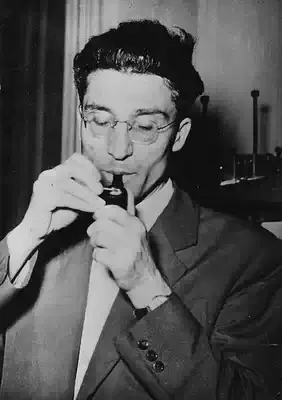
Cesare Pavese
1908–1950
· lived 41 years
 IT
IT
IT
Cesare Pavese was a prominent Italian writer, poet, translator, and literary critic. His work, deeply marked by the experience of war, solitude, and the search for identity, explores themes such as lost childhood, the return to the homeland, and the difficulty of communication. Recognized for his direct style and melancholic view of existence, Pavese left a significant literary legacy, influencing later generations of Italian writers. His tragically interrupted life reflects the intensity and contradictions of his profound artistic sensibility.
n. 1908-09-09, Santo Stefano Belbo · m. 1950-08-27, Turim
1,419
Views
Bio
Identification and basic context
Cesare Pavese was an Italian poet, novelist, translator, and literary critic. He was born in Santo Stefano Belbo, in the province of Cuneo, on September 15, 1908, and died in Turin on August 27, 1950. He was a central figure in 20th-century Italian literature, associated with neorealism, although his work transcends easy labels.Childhood and education
Pavese spent his childhood and adolescence in Santo Stefano Belbo, an experience that would profoundly mark his work, with his homeland being a place of memories and conflicts. He studied at the Liceo Classico "Vittorio Alfieri" in Turin and graduated in Classical Philology from the University of Turin in 1930, with a thesis on Walt Whitman. His classical education and his fascination with Anglo-Saxon literature, especially American literature, were decisive.Literary career
Pavese began his career as a translator, introducing authors such as Sherwood Anderson, Gertrude Stein, William Faulkner, and John Steinbeck to Italy. His first published work was the poetry collection "Lavorare stanca" (1936). His novelistic work gained prominence with "Paesi tuoi" (1941), "La spiaggia" (1942), and his most celebrated novel, "La luna e i falò" (1950), published shortly before his death. He was also an active literary critic and essayist.Work, style, and literary characteristics
Pavese's work is marked by a confessional tone and profound melancholy. Recurring themes include childhood, the search for identity, the return to the land, solitude, unrequited love, war and fascism, and the ambiguous relationship with the rural world. His style is characterized by direct, sometimes harsh, language, but laden with lyricism and symbolism, with a striking use of images and metaphors drawn from the natural world and everyday life.Work, style, and literary characteristics
Cultural and historical context Pavese lived and wrote during a turbulent period in Italian history, marked by fascism, World War II, and the subsequent reconstruction. His work reflects the anxieties and contradictions of that era. He was an interventionist intellectual, initially close to the Italian Communist Party, which led to persecution and exile during the fascist regime. He was one of the founders of the magazine "Cultura" and collaborated extensively with the publishing house Einaudi.Work, style, and literary characteristics
Personal life Pavese's personal life was marked by turbulent love affairs and solitude. His relationship with the actress Constance Dowling inspired "La bella estate" and "La luna e i falò." He suffered from depression, and his personal life was often linked to his frustrations and disappointments, which are evident in his work.Work, style, and literary characteristics
Recognition and reception During his lifetime, Pavese received some recognition, especially as a translator and critic. The Strega Prize in 1950, for his novel "La bella estate," was one of the few significant awards he received. After his death, his work gained cult status and is widely recognized as a landmark in Italian literature, being studied and translated internationally.Work, style, and literary characteristics
Influences and legacy Pavese was influenced by Walt Whitman, Herman Melville, Sherwood Anderson, Gertrude Stein, and other American writers. His legacy lies in his ability to portray the complexity of the human condition, the melancholy of existence, and the deep relationship between the individual and their land and history. He influenced generations of Italian writers, such as Italo Calvino and Pier Paolo Pasolini.Work, style, and literary characteristics
Interpretation and critical analysis Pavese's work is often analyzed from the perspectives of psychoanalysis, existentialism, and neorealism. His narratives explore the difficulty of communication, the search for authenticity, and the relationship between myth and reality.Work, style, and literary characteristics
Curiosities and lesser-known aspects Pavese was known for his introspective temperament and a certain reclusiveness. His passion for American culture was profound, to the point of learning English to read the originals. His death by suicide, from an overdose of barbiturates, shocked the literary world.Work, style, and literary characteristics
Death and memory Cesare Pavese committed suicide in Turin in 1950, leaving a note that read: "I forgive everyone and ask everyone for forgiveness. Is that okay? Don't worry too much. Greetings and the sun keeps turning." His premature death consolidated his image as a literary martyr and increased interest in his work. Posthumous publications continued to expand his literary legacy.Poems
0No poems found
Quotes
7We do not remember days; we remember moments.
No poems found
Videos
50
Comments (0)
Log in
to post a comment.
No comments yet. Be the first to comment.