
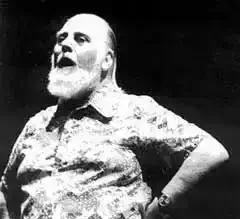
Bob Cobbing
1920–2002
· lived 82 years
 GB
GB
GB
Bob Cobbing was a pioneer of visual and sound poetry, known for his experimental approach and the deconstruction of traditional poetic forms. His work, often performative, explored the materiality of language, the sonority of words, and the relationship between text and image. Cobbing was a central figure in the British artistic avant-garde, promoting experimentation and collaboration.
n. 1920-07-30, Enfield · m. 2002-09-29, Londres
2
Views
Bio
Identification and Basic Context
Bob Cobbing was a British poet, editor, and visual artist, widely recognized as a seminal figure in the development of visual, sound, and experimental poetry. Born in the United Kingdom, Cobbing dedicated his life to exploring the boundaries of poetic language, challenging conventions, and promoting new forms of expression. His work is intrinsically linked to the cultural and artistic context of the second half of the 20th century, a period of intense experimentation and rupture with established traditions.Childhood and Education
Information about Bob Cobbing's childhood and education is not extensively detailed in public sources. However, it can be inferred that his trajectory was marked by a growing dissatisfaction with conventional poetic forms and an increasing interest in the plastic and sonic possibilities of language. His education, largely self-taught in the field of experimental poetry, was shaped by readings and participation in artistic circles that valued innovation.Literary Career
Bob Cobbing's literary career began with a strong inclination towards experimentation. He quickly moved away from traditional poetry to immerse himself in the universe of visual and sound poetry. His evolution over time is marked by constant reinvention, exploring new techniques and collaborating with other artists. Cobbing was a prolific editor, founding and directing the Writers Forum press, which became an important vehicle for disseminating experimental poetry, publishing works by numerous avant-garde artists and poets.Work, Style, and Literary Characteristics
Bob Cobbing's work is characterized by its multimedia and interdisciplinary nature. He intensely explored visual poetry, using graphic elements, typography, and the spatial arrangement of words on the page to create meaning. Concurrently, he dedicated himself to sound poetry, exploring the musicality, rhythm, and textures of the human voice through performances and recordings. Themes such as social critique, the nature of language, and human perception are present in his work. His style is often marked by spontaneity, playful exploration of language, and the breaking of barriers between the arts. Cobbing was associated with avant-garde movements and contributed significantly to the deconstruction of traditional poetic forms, paving the way for new creative approaches.Cultural and Historical Context
Bob Cobbing lived and produced during a period of cultural effervescence in the United Kingdom, especially in the 1960s and 1970s, with the emergence of avant-garde movements that questioned artistic norms. His role as an editor and cultural promoter placed him at the center of experimental literary circles, where he collaborated and dialogued with other artists. His artistic position can be seen as a reflection of the search for new forms of expression in a rapidly changing world.Personal Life
Detailed information about Bob Cobbing's personal life is less accessible in public records. It is known that his life was deeply dedicated to art and the promotion of experimental poetry. His dedication to the Writers Forum press and his performance and collaboration activities indicate a total commitment to his craft. It is likely that his artistic and philosophical convictions shaped his personal journey.Recognition and Reception
Although Bob Cobbing may not have achieved the mainstream recognition of more traditional poets, he is widely respected and celebrated within the circles of experimental and visual poetry. His legacy is recognized for his innovation, his dedication to the artistic community, and the influence he exerted on subsequent generations of artists.Influences and Legacy
Bob Cobbing was influenced by pioneers of concrete and experimental poetry, and he himself influenced numerous visual and sound poets, both in the UK and internationally. His legacy lies in expanding the possibilities of poetry, demonstrating that language can be explored in visual, sonic, and performative ways. His work continues to inspire artists to experiment with the form and substance of the word.Interpretation and Critical Analysis
Cobbing's work invites multiple interpretations, focusing on the materiality of language, the relationship between sound and meaning, and the critique of social and artistic structures. His experimental approach challenges conventional critical analyses, requiring new perspectives for the understanding of his work.Curiosities and Lesser-Known Aspects
A notable aspect of Bob Cobbing is his tireless activity as an editor and promoter of other artists through Writers Forum, often operating with limited resources. His passion for experimentation was evident in his vibrant performances and in the way he encouraged creativity in all his projects. His playful approach and his dedication to making poetry accessible and challenging at the same time are striking aspects of his profile.Death and Memory
Bob Cobbing passed away in 2000, leaving behind a vast body of work and a lasting legacy in experimental poetry. The memory of his contribution is kept alive through the study of his work, the publications he edited, and the generations of artists he inspired.Poems
0No poems found
Comments (0)
Log in
to post a comment.
No comments yet. Be the first to comment.