
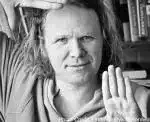
Barrie Phillip Nichol
 CA
CA
Barrie Phillip Nichol was a Canadian poet known for his experimental and visual approach to poetry. His work challenged literary conventions, exploring new forms of expression that integrated visual and sonic elements. He was an influential figure in contemporary Canadian poetry, leaving a legacy of innovation and experimentation. Nichol worked with diverse media, including the creation of poetic objects, films, and performances. His experimentation sought to expand the boundaries of what poetry could be, making it a more holistic and multi-sensory experience.
n. 1944-09-30, Vancouver · m. 1988-09-25, Toronto
Bio
Identification and basic context
Barrie Phillip Nichol (1942-1988) was a Canadian poet, writer, and artist. He is widely recognized for his experimental and visual approach to poetry, challenging traditional forms and exploring new possibilities of expression.Childhood and education
Nichol was born and raised in Canada. His specific education and influences are less publicly documented, but his work suggests a strong inclination towards visual art and experimentation.Literary career
Nichol began his literary career during a period of artistic effervescence in Canada, marked by a desire for innovation and a break from established traditions. He was a central figure in the group of poets known as "The Four Horsemen," along with bpNichol, David W. Harris, and Robert McTavish, who were distinguished by their poetic performances and the creation of poetic objects.Work, style, and literary characteristics
Barrie Phillip Nichol's work is characterized by visual and sonic experimentation. He explored concrete poetry, visual poetry, and the creation of poetic objects, often integrating graphic elements, textures, and three-dimensional forms. His style challenged the linearity of written language, seeking more direct and multi-sensory communication. He often worked collaboratively, expanding the boundaries of individual authorship.Cultural and historical context
Nichol emerged in a cultural context that saw the flourishing of experimental artistic movements in Canada, particularly in the 1960s and 1970s. The group "The Four Horsemen" pioneered poetic performances that mixed poetry, music, theater, and visual arts, responding to a desire for new art forms that reflected the complexity of the modern world.Personal life
Nichol had a life marked by his dedication to art and experimentation. His personal relationships and life experiences shaped his artistic vision, which often addressed themes of identity, communication, and the nature of reality.Recognition and reception
While the experimental nature of his work may have limited its mainstream reach, Nichol is widely respected in the field of experimental poetry and visual art. He is considered an important figure in the history of contemporary Canadian poetry and a precursor to many artistic practices that would become more common later.Influences and legacy
Nichol was influenced by visual artists, concrete poets, and the artistic avant-garde. His legacy lies in his courage to explore the limits of poetic form and his contribution to visual and performance poetry in Canada. He inspired generations of artists to experiment with language and media.Interpretation and critical analysis
Nichol's work invites multiple interpretations, challenging the reader to engage with poetry in a more active and sensory way. His explorations of communication and identity resonate with existential and philosophical questions.Curiosities and lesser-known aspects
Nichol was known for his creative energy and his ability to transcend disciplinary boundaries. His collaboration with "The Four Horsemen" resulted in memorable performances and the creation of unique poetic objects that are valued today by collectors and institutions.Death and memory
Barrie Phillip Nichol passed away in 1988. His memory is kept alive through the study of his work, the preservation of his archives, and the continuing influence of his work on experimental poetry and visual arts.Poems
0No poems found
Comments (0)
No comments yet. Be the first to comment.