
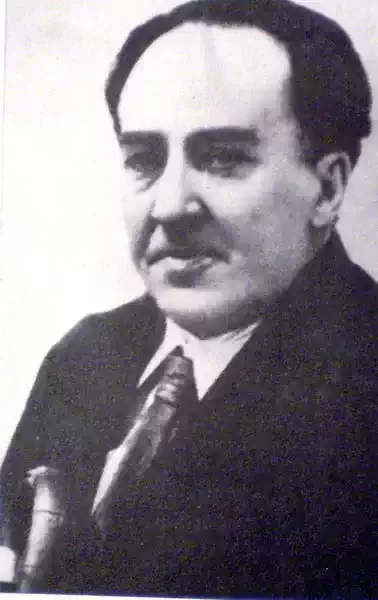
Antonio Machado
1875–1939
· lived 63 years
 ES
ES
ES
Antônio Machado was a Spanish poet, a prominent figure of the Generation of '27, although his work is often associated with the Generation of '98 due to its deep reflection on Spanish identity and the Castilian landscape. His poetry is marked by introspection, melancholy, and a constant search for the meaning of life, death, and time. He stands out for his contained lyricism, philosophical reflection, and exploration of memory and dreams.
n. 1875-07-26, Sevilha · m. 1939-02-22, Collioure
66
Views
Bio
Identification and basic context
Antonio Machado Ruiz was a Spanish poet, considered one of the greatest figures in 20th-century Spanish literature. He was a member of the Royal Spanish Academy. He was born and died in Spain.Childhood and education
Born in Seville, Machado spent much of his childhood and youth in Madrid. His intellectual education was profound, marked by the liberal and intellectual environment of his family. He studied at the Institución Libre de Enseñanza, where he came into contact with the progressive pedagogical ideas of the time.Literary career
Machado began his literary career in a context of poetic renewal in Spain. His work evolved from a more intimate and modernist lyricism to a more philosophical and reflective poetry, especially after the loss of his wife, Leonor Izquierdo. He published in various literary magazines and was one of the founders of the magazine "La Pluma".Work, style, and literary characteristics
His main works include "Soledades" (1903), "Campos de Castilla" (1912), and "Nuevas Canciones" (1924). The dominant themes are the passage of time, death, memory, dreams, the Castilian landscape, and Spanish identity. His style evolved from an intimate symbolism to a more austere, meditative poetry with precise vocabulary. The poetic form varied between the sonnet and free verse, with great attention to rhythm and musicality.Cultural and historical context
Machado lived in a time of profound transformations in Spain, including the loss of the last colonies in 1898, the Spanish Civil War, and the establishment of Franco's dictatorship. He was part of the Generation of '98, a group of intellectuals and writers who focused on the crisis of Spanish identity. He maintained relationships with other writers of the time, such as Juan Ramón Jiménez and Miguel de Unamuno.Personal life
Machado's personal life was marked by the premature death of his wife, Leonor Izquierdo, in 1912, an event that had a profound impact on his work, giving it a more elegiac and melancholic tone. He was known for his discretion and his ethical and civic stance.Recognition and reception
Although his work was recognized by critics and other writers during his lifetime, his definitive consecration as one of the greatest Spanish poets occurred largely after his death. His poetry became a symbol of cultural resistance during Francoism.Influences and legacy
Machado was influenced by poets such as Bécquer and Verlaine. His legacy is immense, having influenced generations of Spanish-language poets. His work is a pillar of the Spanish literary canon and continues to be widely studied and admired.Interpretation and critical analysis
Machado's work is often analyzed from the perspective of his profound meditation on the human condition, the passage of time, and the search for meaning in a constantly changing world. His poetry is seen as a reflection of the Spanish soul.Curiosities and lesser-known aspects
Machado was a man of simple habits and dedicated much of his life to writing and reflection. He was also a political thinker, albeit discreetly.Death and memory
Antonio Machado died in Collioure, France, in 1939, one year after the end of the Spanish Civil War, while in exile. His death became a tragic symbol. Posthumous publications continued to disseminate his work.Poems
0No poems found
Quotes
18No poems found
Comments (0)
Log in
to post a comment.
No comments yet. Be the first to comment.