Identification and Basic Context
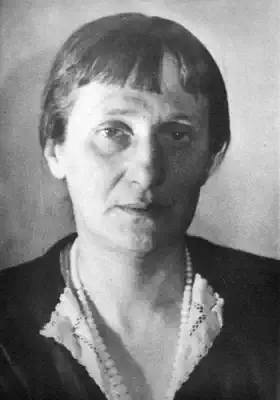
Anna Andreevna Gorenko, better known by the pseudonym Anna Akhmatova, was a Russian poet, considered one of the most prominent figures in 20th-century Russian literature. Born near Odessa, she spent most of her life in Saint Petersburg (then Petrograd and Leningrad). She was one of the founders of the Acmeist literary movement.
Childhood and Education
Akhmatova was born into a family of Russian nobility. She spent her childhood and adolescence in Tsarskoe Selo (present-day Pushkin), a resort frequented by the Russian intelligentsia. She studied at the Smolny Institute for Noble Maidens and later attended law and philology courses at the University of Kiev and the University of Saint Petersburg, although she did not complete her formal studies. She was influenced by Russian Symbolist poetry and European culture, but quickly developed her own style.
Literary Career
Her first collection of poems, "The Rosary" (1912), achieved immediate success and established her as an important voice on the Russian literary scene. Akhmatova became a central figure of Acmeism, a movement that opposed the mysticism and obscurity of Symbolism, advocating for clarity, precision, and objectivity in poetic language. Throughout her life, her work evolved, becoming darker and more engaged with the historical tragedies she witnessed.
Work, Style, and Literary Characteristics
Akhmatova's work is characterized by intense and introspective lyricism, exploring the depths of love, loss, memory, and the human condition. Her poems are often short but charged with emotion and meaning. Themes such as unrequited love, absence, ephemeral beauty, and spiritual resilience in the face of suffering are recurrent. Her style is marked by vocabulary precision, verse musicality, and an impressive ability to evoke vivid imagery. "Requiem" (written between 1935-1940, published posthumously), a cycle of poems recounting the terror of Stalinist persecutions, is one of her most powerful and emblematic works.
Cultural and Historical Context
Akhmatova lived and wrote during one of the most turbulent periods in Russian history: World War I, the October Revolution, the Russian Civil War, Stalinist repressions, and World War II. Her literary circle included poets such as Osip Mandelstam and Nikolai Gumilev (her first husband). She was expelled from the Union of Soviet Writers in 1946 and was persecuted again in the following years. Her life and work are intrinsically linked to the suffering and resistance of the Russian people.
Personal Life
Akhmatova's life was marked by personal losses and political persecution. Her first husband, Nikolai Gumilev, was executed in 1921. Her son, Lev Gumilev, was arrested and sent to forced labor camps several times. Akhmatova lived under constant threat but refused to leave Russia or renounce her art. Her romantic relationships, such as her love for Nikolai Punin, also left deep marks on her poetry.
Recognition and Reception
During her lifetime, Akhmatova was widely recognized in Russia and abroad, despite the difficulties imposed by the Soviet regime. She received the International Literary Prize for Poetry in 1965. After her death, her work continued to gain recognition and be translated into numerous languages, consolidating her status as one of the greatest poets of the 20th century.
Influences and Legacy
Akhmatova was influenced by poets such as Alexander Blok and by Russian lyrical traditions. In turn, she influenced generations of Russian and foreign poets with her courage, her expressive power, and her ability to combine art with the denunciation of injustice. Her legacy is that of a poet who knew how to transform individual and collective suffering into immortal art.
Interpretation and Critical Analysis
Akhmatova's work is often analyzed from the perspective of her personal and historical experience, but also as a universal exploration of the human condition. Her poetry is seen as a testament to the resilience of the human spirit in the face of oppression and adversity.
Curiosities and Lesser-Known Aspects
Akhmatova was known for her elegance and aristocratic bearing, even in the most difficult times. She had a photographic memory and a unique ability for poetic improvisation. Her figure became a symbol of cultural resistance in Russia.
Death and Memory
Anna Akhmatova died in Koltushi, near Leningrad. The posthumous publication of much of her work, especially "Requiem," allowed her voice to resonate fully, consecrating her as an icon of literature and resistance.

 UA
UA