
If we evolved a race of Isaac Newtons, that would not be progress. For the price Newton had to pay for being a supreme intellect was that he was incapable of friendship, love, fatherhood, and many other desirable things. As a man he was a failure; as a monster he was superb.
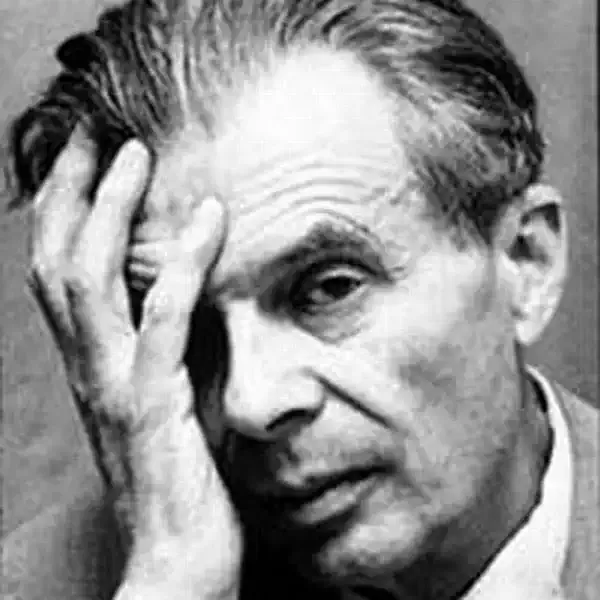
Aldous Huxley
1894–1963
· lived 69 years
 GB
GB
GB
Aldous Huxley was a prominent English writer, known for his vast body of work spanning novels, essays, short stories, and poetry. His writing is marked by profound intelligence, a critical view of society, and a constant exploration of themes such as technology, spirituality, sexuality, and human potential. "Brave New World" is his most celebrated work, a visionary dystopia that continues to resonate for its insight into humanity's future.
n. 1894-07-26, Godalming · m. 1963-11-22, Los Angeles
11,035
Views
Bio
Identification and Basic Context
Aldous Leonard Huxley was a British writer, novelist, and essayist. Born on July 26, 1894, in Godalming, Surrey, England, he passed away on November 22, 1963, in Los Angeles, California, USA. He belonged to a prominent family of intellectuals, being the grandson of Thomas Henry Huxley, an influential biologist. He wrote primarily in English.Childhood and Education
Huxley was born into a family with a strong intellectual and scientific tradition. His father, Leonard Huxley, was a writer and editor, and his grandfather, T.H. Huxley, a prominent biologist and defender of Darwinism. His mother, Julia Arnold, was also a writer. Huxley's childhood was marked by the early loss of his mother and by health problems, notably an eye condition that left him partially blind during a critical period of his youth, forcing him to learn to read and write in braille. He attended Eton College and later studied English literature at the University of Oxford, where he demonstrated a brilliant intellect. His readings spanned literature, philosophy, and sciences, absorbing the intellectual spirit of the age.Literary Career
Huxley began his literary career as a poet but quickly turned to prose, writing novels, short stories, and essays. His early work reflected an intellectual skepticism and sharp social criticism. He gained notoriety with "Point Counter Point" (1928) and, above all, with "Brave New World" (1932), which became a landmark of dystopian fiction. Throughout his career, Huxley explored various themes, from criticism of industrial and technological society to research on consciousness, spirituality, and psychedelic drugs.Work, Style, and Literary Characteristics
Aldous Huxley's work is vast and diverse. "Brave New World" is his most famous work, presenting a futuristic society rigidly controlled through genetic engineering, psychological conditioning, and the use of drugs to keep the population happy and docile. Other important works include "The Doors of Perception" (1954), an account of his experience with mescaline, and "Island" (1962), a utopia that contrasts with his earlier dystopian work. Huxley's style is characterized by his penetrating intelligence, his encyclopedic knowledge, and his clear and precise prose. His novels often feature intellectual characters and explore complex ideas, using witty dialogue and a narrative that combines satire with philosophical depth. Recurring themes in his work include criticism of technology and unchecked progress, the exploration of human consciousness, the search for spirituality, sexuality, and the nature of reality.Work, Style, and Literary Characteristics
Cultural and Historical Context Huxley lived in a period of great social, political, and technological transformations, including the two World Wars, the advancement of science, and the rise of totalitarian regimes. His work reflects these concerns, analyzing the impact of scientific and social progress on the human condition. He was influenced by thinkers such as D.H. Lawrence and Sigmund Freud, and maintained contact with other intellectuals and artists of his time.Work, Style, and Literary Characteristics
Personal Life Huxley's personal life was marked by health challenges and an intense intellectual and spiritual quest. After a period of disillusionment with Western life, he moved to California, where he became increasingly interested in Eastern philosophies, mysticism, and the use of psychedelic substances as tools for expanding consciousness. His marriage to Maria Nys and, later, to Laura Archera, were significant relationships. His exploration of the use of LSD and psilocybin, documented in "The Doors of Perception" and "Heaven and Hell," marked an important period of his life and work.Work, Style, and Literary Characteristics
Recognition and Reception Huxley was an acclaimed author during his lifetime, especially after the success of "Brave New World." His work was translated into numerous languages and continued to be widely discussed and studied. Although not all of his works received the same universal recognition, his influence, particularly through "Brave New World," is undeniable.Work, Style, and Literary Characteristics
Influences and Legacy Huxley influenced generations of writers, thinkers, and social critics with his visions of the future of society and technology. His legacy lies in his ability to anticipate social and technological concerns that have become central in the 21st century. His works remain relevant to debates on artificial intelligence, genetic engineering, social control, and the search for meaning in a constantly changing world.Work, Style, and Literary Characteristics
Interpretation and Critical Analysis Huxley's work is often analyzed from the perspective of social and philosophical criticism. "Brave New World" is interpreted as a warning about the dangers of a society that sacrifices individual freedom and emotional depth in favor of stability and superficial pleasure. His investigations into consciousness explore the limits of the human mind and the potential for transcendental experiences.Work, Style, and Literary Characteristics
Curiosities and Lesser-Known Aspects Aldous Huxley was a vegetarian and an animal rights advocate. He was a friend of George Orwell, who wrote "1984," another famous dystopia, and the two authors shared concerns about the future of society, albeit with different approaches.Work, Style, and Literary Characteristics
Death and Memory Aldous Huxley died of cancer on the same day that John F. Kennedy was assassinated. His last request was to be injected with LSD by his wife, Laura Archera Huxley, so that he could face death with a greater expansion of consciousness. His work continues to be celebrated and studied, maintaining its relevance as one of the most important thinkers and writers of the 20th century.Poems
0No poems found
Quotes
40How do you know that the earth isn’t some other planet’s hell?
[ Describing a mescaline-induced experience :] I looked down by chance, and went on passionately staring by choice, at my own crossed legs. Those folds in the trousers—what a labyrinth of endlessly significant complexity! And the texture of the gray flannel—how rich, how deeply, mysteriously sumptuous!
“If you look up ‘Intelligence’ in the new volumes of the Encyclopaedia Britannica ,” he had said, “you’ll find it classified under the following three heads: Intelligence, Human; Intelligence, Animal; Intelligence, Military. My stepfather’s a present specimen of Intelligence, Military.”
No poems found
Comments (0)
Log in
to post a comment.
No comments yet. Be the first to comment.